

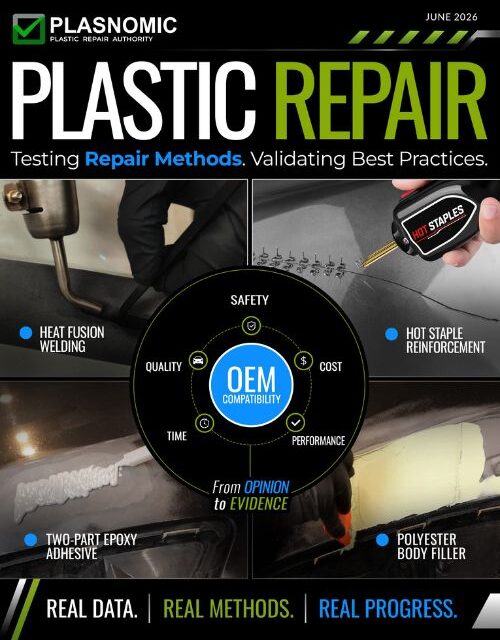
Plasnomic has entered the next stage of its polypropylene bumper repair evaluation program, moving beyond material compatibility testing and into a structured comparison of the four primary repair processes used across the collision repair industry.
The evaluation will compare:
- Two part glues and epoxies
- Plastic finishing fillers
- Hot staple reinforcement,
- Fuse welding with polypropylene compatible repair material.
The assessment will be based on a combination of real life repair conditions,
technical process evaluation, and lab based performance data. This approach is designed to ensure the results reflect both scientific validation and the practical realities of collision repair operations.
The objective is to determine which repair processes are most technically suitable, OEM compatible, repeatable, safe, cost effective, and practical for modern polypropylene bumper repairs.
This marks an important step toward the development of science based best practices for plastic repair, supported by measurable data rather than opinion, habit, supplier claims, or individual shop preference.
“We are excited to bring this next development to the industry as we move closer to establishing data driven, technical best practices for plastic repairs,” said Mario Dimovski, Head of the Plasnomic Global Council.
Why Polypropylene Bumper Repair Needs Deeper Evaluation
Polypropylene bumper covers are among the most commonly damaged parts in collision repair. They are also among the most frequently replaced, even when repair may be technically possible.
These materials all form part of the polypropylene family of plastic bumpers, which includes common bumper cover materials such as PP, PP/EPDM, TPO, PP with talc filler, PP/EPDM-TD, PP copolymer, PP+PE, and TEO. While the exact blend may vary by manufacturer, they are all polypropylene-based or
polyolefin-based plastics commonly used in modern automotive bumper covers because they provide the right balance of flexibility, impact resistance, durability, and repairability.
Today, repair decisions remain inconsistent. One technician may use filler. Another may use staples. Another may rely on a two part adhesive. Another may weld the plastic using polypropylene compatible material.
Each process can produce a repair that looks acceptable on the surface. The more important question is how that repair performs beneath the finish.
Does the repair maintain flexibility? Does it restore strength without creating a rigid stress point? Does it add unnecessary thickness? Does it affect ADAS sensitive areas? Does it remain compatible with the original bumper material? Can it be repeated consistently across technicians, shops, climates, and damage types? Is it profitable and practical for the collision repair center?
These are the questions Plasnomic is now working to answer through a structured benchmarking program.
Benchmarking the Repair Process, Not Just the Final Appearance
One of the biggest challenges in plastic repair is that many repairs are judged primarily by appearance. If the bumper looks finished, smooth, and properly refitted, the repair is often accepted.
Plasnomic believes the industry must move beyond visual assessment.
A proper repair evaluation must consider how the part performs after repair, how the material behaves under stress, and how the repair may affect modern vehicle systems.
Plasnomic’s methodology will benchmark each process across real life repair conditions, technical workflow assessment, and lab based performance data. Core evaluation areas will include repair time, true material and labor cost, equipment requirements, technician repeatability, safety, flexibility, repair thickness, strength, durability, ADAS compatibility, and sustainability impact.
The purpose is not simply to declare one method better than another. The goal is to define where each process is appropriate, where limitations may exist, and what method delivers the most OEM compatible outcome for each repair type.
ADAS Compatibility Will Be a Critical Focus
Modern bumper covers are no longer simply cosmetic panels. Many now sit in front of radar, parking sensors, blind spot systems, and other driver assistance technologies.
That means the repair process used on a bumper may matter more than ever.
Material thickness, density, reinforcement type, repair location, and substrate consistency can all become important factors when repairing ADAS sensitive areas.
For example, a process that adds metal staples, heavy filler, thick adhesive, or inconsistent material layers may not be appropriate in certain sensor zones. A repair method that maintains a more consistent polypropylene structure may prove more compatible, but this must be verified through proper testing and documentation.
Plasnomic’s benchmarking program will place specific focus on ADAS sensitive areas to help the industry better understand which repair methods are appropriate, limited, or unsuitable depending on repair location and vehicle technology.
Building From the First Stage of Testing
Plasnomic recently completed the first stage of its global polypropylene bumper repair benchmarking initiative. That phase evaluated weld materials and fusion repair methodologies from 11 globally recognized plastic repair solution providers across North America, Europe, and Asia Pacific.
The objective was to identify repair materials and fusion methods that most closely preserve the original characteristics, flexibility, and performance behavior of OEM polypropylene bumper systems.
Initial testing showed meaningful variation between materials and weld methods, confirming the need for an OEM compatible benchmark substrate before comparing repair processes more broadly.
Creating a Practical Standard for Collision Shops
This work is not intended to become a laboratory exercise disconnected from real shop conditions. Plasnomic is focused on building a practical, usable standard that can support collision repair centers, insurers, OEM stakeholders, training organizations, and suppliers.
The final outcome must help answer everyday repair questions.
Which damage types should be repaired? Which repair process should be used? Which areas should not be repaired with certain methods? How should technicians be trained? How should repair quality be documented? How should insurers and shops evaluate repair versus replacement? How can repaired plastic parts be certified with confidence?
This is where Plasnomic’s role becomes important. The industry does not simply need more products. It needs tested processes, documentation, certification, traceability, and clear best practice pathways.
Moving Toward OEM Compatible Plastic Repair
Plasnomic’s long term objective is to support the development of safer, more consistent, and OEM conscious plastic repair methods. This includes defining which processes best preserve the original characteristics of polypropylene bumper covers and which methods may require limits, conditions, or specific use cases.
This approach allows the industry to move away from a one size fits all repair mindset and toward a more intelligent repair decision model.
As modern vehicles become more complex, plastic repair can no longer be governed by appearance alone. The future of plastic repair must be supported by real world validation, lab based data, technical documentation, and process based compliance.
That is the clarity Plasnomic is working to bring to the industry.
