

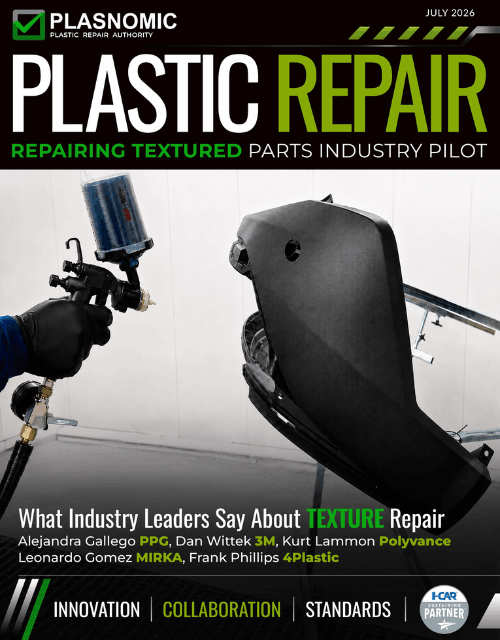
Modern collision repair is entering a new phase, and one of the industry’s largest untapped opportunities is sitting in plain sight.
Textured plastic parts are now found throughout modern vehicles, including lower bumper covers, wheel-arch moldings, rocker moldings, exterior cladding, bumper inserts, grille surrounds and trim components. They have become important elements of vehicle design, aerodynamics and functional protection.
Yet in most collision repair environments, these components are still treated almost exclusively as replacement parts.
Plasnomic’s industry-first Textured Parts Repair Pilot is challenging that mindset by addressing one of the collision industry’s most underdeveloped repair categories.
The pilot is being launched in collaboration with leading industry partners, including 3M, 4Plastic, Mirka, PPG, Polyvance and SEM. It brings together collision repair groups, insurers, suppliers and technical partners to validate repair methods, test available products, measure commercial benefits, develop training pathways and establish industry best practices.
This initiative is not simply about proving that a textured plastic part can be repaired. It is about building the complete framework that allows repair facilities to determine when repair is appropriate, how it should be performed, how it should be priced, how technicians should be trained and how the final result should be documented and trusted.
For the collision repair industry, this is the difference between an occasional repair technique and a scalable repair-first standard.
The Financial Benefit for Shops
The financial benefit for collision repair facilities could be significant.
When a textured part is replaced, the shop may earn a parts margin, but it often loses the opportunity to generate skilled labor and material revenue. Replacement can also create delays, supplements, mirror-matching issues, storage challenges and additional administrative work.
Repair changes the economics.
A properly priced textured repair can generate labor sales, improve gross profit, reduce parts dependency and keep the vehicle moving through production. It can also create additional
work for technicians and painters at a time when claim volumes, labor availability and repair economics remain under pressure.
Plasnomic’s pilot aims to help repairers convert what was previously a replacement decision into a skilled and measurable repair operation.
Repair-first is not only a sustainability message. It is a profitability strategy.
For repairers, the opportunity is increased labor and material revenue. For insurers, it is reduced parts expenditure and potentially improved cycle time. For customers, it can mean a faster repair. For the industry, it creates a stronger and more sustainable claims model.
What Industry Leaders Are Saying
Below, industry leaders share their perspectives on the opportunity and the importance of developing a recognized approach to textured plastic repair.
Alejandra Gallago – SEM Products: Business Director – Allied Products, Refinish
Textured plastic repair has been one of the areas where the industry has needed more structure, more testing and more practical repair guidance. This pilot creates the right environment to evaluate process, materials and technician workflow in real collision repair conditions. We are proud to support an initiative that helps shops repair more, reduce unnecessary part replacement and build stronger best-practice standards for the future.”
Dan Wittek – Director, 3M: Global Application Engineering
Increasing labor time on an estimate through efficient and profitable plastic repair operations remains as one of the largest opportunities our industry is leaving on the table. But it’s not anyone’s fault… Lack of training, OEM position statements, complicated surface geometries, textures and more leave some feeling like it’s not worth the effort and default to R&R with plastic parts. The reality is that many parts are still repairable and just because we weren’t successful before or didn’t have the know how previously doesn’t mean we shouldn’t try again! This pilot is a great first step in “trying again” so we may all have a more sustainable and profitable future.
Kurt Lammon – Polyvance President
“Auto body repair and refinishing has always been a blend of art and science, which is what draws many technicians to the trade. Texture refinishing especially depends on the artistic side of the painter’s talents. There are many factors involved in the final appearance of the texture including product reduction, paint gun setup, air pressure, distance to the work, and speed of the pass. These factors can repel some painters as being too much trouble but can equally attract those looking to provide a better, faster solution for their customer, especially in self-pay situations.”
Leo Gomez – Mirka Global Business Manager Collision
“Successful plastic repair depends on consistency, process control and the right surface preparation. By participating in this pilot, we can help validate how abrasives, tools and repair methods perform in a real production environment. The goal is to give technicians a repeatable process that supports quality outcomes while helping collision centers improve efficiency and profitability.”
Frank Phillips – CEO of 4Plastic
“Textured plastic has long been a huge overlooked opportunity in the collision industry. The results from the texture pilot will give the industry the data, materials, process, and most importantly the confidence to repair these parts that have been traditionally disposed of.
4Plastic is honored to be one of the industry partners involved in this pilot. We believe that together with other participating partners we will be able to drive repairability into this unique area of collision repair.”
Mario Dimovski – President & Head of Council, Plasnomic
“Textured plastic repair represents a significant commercial opportunity for collision repair facilities. By repairing more of these components rather than automatically replacing them, shops can retain more labour and material revenue, increase gross profit and create additional productive work for both body technicians and refinish teams. At the same time, insurers can benefit from a lower total cost of repair, reduced parts expenditure and improved cycle times. This is a repair-first opportunity that can create measurable value across the entire collision repair ecosystem.”
The Replacement Problem
For many years, textured plastic parts have sat outside the normal repair conversation. Smooth bumper covers can be repaired and refinished using established processes.
Textured parts, however, have often been replaced once their grain, surface appearance or molded texture is damaged.
That default decision is becoming harder to justify.
Industry research referenced in Plasnomic’s pilot release suggests that more than 95% of textured plastic parts are replaced, including many with minor scratches or repairable damage. At the same time, these parts are becoming increasingly expensive. Some small wheel-arch moldings sell for more than $300, while certain lower bumper covers can cost more than the main bumper cover itself.
This places pressure across the repair ecosystem. Insurers face rising parts costs. Repairers lose skilled labor opportunities. Customers may experience delays while parts are sourced, and the environment absorbs additional plastic waste.
The question is not whether every textured part should be repaired. Severe damage, critical mounting failures, structural compromise, heavy deformation, contamination or unacceptable appearance limitations will still require replacement.
The real question is whether the industry has a reliable method for determining which parts can be repaired safely, consistently and profitably. At present, that framework is not strong enough.
Testing the Right Products on the Right Parts
Textured plastic repair is not one single repair type.
A light scuff on a lower bumper valance is different from a deep gouge in a wheel-arch molding. Fine-grain trim differs from heavily patterned rocker cladding. A low-mounted part exposed to road debris has different durability demands from trim located higher on the vehicle.
A cosmetic repair also differs from a repair requiring reshaping, welding or material rebuilding before the texture can be restored.
Product testing must therefore be matched to real repair conditions.
Some products may perform well for light surface restoration but not deeper damage. Others may provide strong adhesion but struggle to reproduce the original texture. Some may look acceptable immediately but fail after weathering, washing or impact exposure.
The pilot must identify where each product works, where it does not and what limitations must be communicated.
The goal is not to force one solution across every part. It is to establish the correct product and process for each repair category.
Plasnomic’s role as an independent repair authority is important in creating a neutral framework that evaluates products, tests repair outcomes and provides guidance that shops can trust.
Pricing the Repair Correctly
One of the largest barriers to textured plastic repair is commercial rather than technical.
Advanced repair work must be priced properly. Too often, plastic repair operations are undercharged, absorbed into other labor lines or completed without clear compensation.
Textured plastic repair should be priced as both a labor and material operation.
The labor component should account for inspection, preparation, repair execution, texture application, finishing, quality control and documentation. The material component should reflect cleaners, abrasives, adhesion promoters, repair products, texture coatings, masking materials and other consumables.
Shops should not treat textured repair as a free add-on. When the repair avoids replacement, lowers parts expenditure, supports cycle time and delivers a quality result, it creates measurable value.
The pilot therefore includes pricing strategy, labor identification and labor allocation as major areas of study.
A successful pricing model must be simple enough for estimators to use while still reflecting repair complexity, size, labor time, material consumption, finishing requirements and documentation.
This is how textured repair can move from an occasional skill to a recognized business model.
Training: The Bridge Between Product and Performance with Partners like I-CAR
A product alone will not change the industry.
Even the best repair material can fail when a technician does not understand preparation, application, texture matching, curing, finishing or inspection.
Textured repair is highly visual and technique-driven. The final appearance may depend on product choice, surface preparation, spray distance, air pressure, application speed, surrounding texture, lighting and technician judgment.
Training, with assistance from industry leaders like I-CAR must therefore sit at the center of the program.
Technicians need to understand how to:
- Inspect and classify the damage
- Identify repairable and non-repairable conditions
- Prepare the surface correctly
- Select and apply the appropriate product
- Recreate and blend the texture
- Inspect and document the completed repair Training must also extend beyond technicians.
Estimators need to identify and write the repair. Production managers must route the work to appropriately trained staff. Quality-control teams must know how to inspect it, while shop leaders need to measure repair rates, profitability and outcomes.
The training model should remain practical but structured, with pathways for basic cosmetic repairs, advanced repairs and trainer-level certification.
Training creates confidence. Confidence creates adoption. Adoption creates culture change.
Changing the Culture From Replace-First to Repair-First
The technical process is only half the challenge. The other half is culture.
Many repair businesses have developed a replace-first rhythm because replacement has traditionally appeared easier. Estimators may not know how to write the operation.
Technicians may not have received training. Insurers may not understand the process, and managers may not measure the lost opportunity.
Changing this behavior requires more than launching a product. It requires a change in shop decision-making.
During blueprinting, textured parts should be inspected for repair potential before replacement is selected. Estimators should classify the damage as cosmetic, repairable, advanced or non-repairable. Technicians should be involved early where the decision is unclear, and managers should measure repair-versus-replacement performance.
For decades, the industry has discussed repair-first strategies, but many repair categories still lack the standards required to support them.
Textured plastic repair creates an opportunity to show what repair-first looks like when it is built correctly.
The shop no longer asks only, “Can we replace this?”
It asks, “Can we repair this correctly, profitably and safely?”
The Environmental Layer
Collision repair produces a significant amount of plastic waste. Bumper covers, moldings, cladding and trim components are regularly removed and discarded. While some materials enter recycling streams, many still end up in landfill or low-value recovery channels.
Every repairable part retained on the vehicle avoids unnecessary waste.
The environmental value of textured repair should be measured rather than treated as a general marketing claim. The pilot should track the number of parts repaired instead of replaced, the estimated weight of plastic diverted, the avoided replacement cost and the broader sustainability impact.
This data can support stronger reporting to insurers, customers, MSOs, suppliers and OEMs.
Repair extends the useful life of materials already in circulation. As sustainability becomes more important to insurers, fleets, manufacturers and consumers, textured plastic repair gives the collision industry a practical way to reduce waste without compromising quality.
Why Collaboration Is Essential
No single company can build this category alone.
Textured plastic repair touches every part of the repair ecosystem. Suppliers must validate products. Technicians must apply them correctly. Repairers must price and document the work. Insurers must understand its value. Trainers must provide consistent education, and customers must trust the outcome.
The pilot brings together Plasnomic, 3M, 4Plastic, Mirka, PPG, Polyvance, SEM, collision partners and insurance collaborators to develop an industry-leading repair-first framework.
Its strength is that it does not treat textured repair as a single-company product launch. It treats it as an industry challenge requiring an industry solution.
The Road Ahead
The future of textured plastic repair will not be determined by whether one technician can repair one part in one facility. It will be determined by whether the industry can create a repeatable system that works across many shops, technicians, products and repair conditions.
That system must answer the essential questions:
Which parts are repairable? Which products should be used? How should repairs be tested? How should technicians be trained? How should estimates be written? How should quality be documented? How should sustainability benefits be measured? How should repairers be compensated fairly?
The Plasnomic Textured Parts Repair Pilot is designed to begin answering these questions.
The opportunity is clear. Textured parts are becoming more common, replacement rates remain extremely high, costs continue to rise and repair facilities need additional labor opportunities. Insurers need greater cost control, customers need efficient repair outcomes and the industry needs more sustainable solutions.
Textured plastic repair sits at the intersection of all these needs.
The next step is to move from informal repair possibility to a formal repair standard by testing the right products, defining the correct processes, training technicians, establishing pricing, documenting outcomes and changing the culture from replace-first to repair-first.
For collision repair, this is more than a new repair category.
It is an opportunity to prove that technical innovation, shop profitability, insurer value, customer service and environmental responsibility can move in the same direction.
