

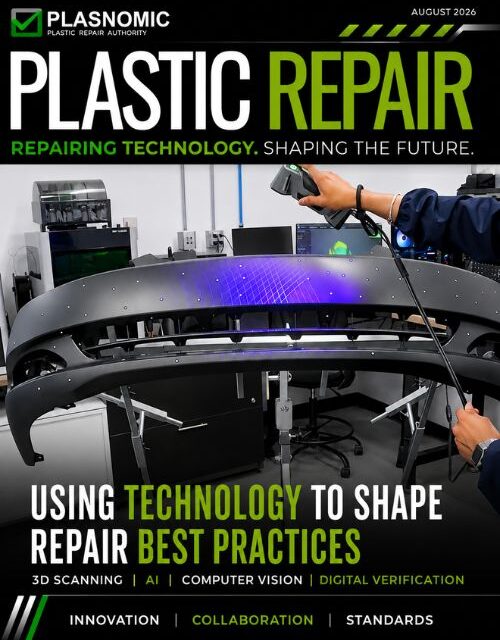
How 3D scanning, computer vision, artificial intelligence and precision measurement can help the collision industry move from opinion-based repair toward evidence-led practices
As Plasnomic moves from testing into real-world validation, technology is playing an increasingly important role in helping us better understand plastic damage, repair processes, tools, equipment and final repair outcomes.
Plastic repair has traditionally relied heavily on technician experience, visual inspection and individual judgment. Those skills remain essential. However, as modern vehicle components become more complex and replacement costs continue to rise, the collision industry needs greater consistency in how plastic damage is assessed, repaired and verified.
Plasnomic is using technologies such as 3D scanning, computer vision, artificial intelligence and precision measurement to gather objective information about the original damage, the repair methodology and the finished result.
The goal is not to replace skilled technicians or their experience. It is to support their knowledge with measurable evidence, better understand the variables that influence repair quality and help the industry develop more consistent, validated and repeatable plastic repair best practices.
Measuring Damage and Repair Outcomes
Throughout its testing and validation programs, Plasnomic has used different technologies to better understand plastic damage, compare repair methodologies and evaluate finished repair outcomes.
A bumper cover may appear to have a simple dent, split or distortion, but the damage can also involve stretched material, displaced body lines or changes in the component’s geometry that are not always visible during a standard inspection.
High-resolution photography and 3D scanning allow Plasnomic to create a detailed digital record of a component before, during and after repair. By digitally overlaying these scans, researchers can measure the depth and area of the original damage and assess how closely the component has returned to its intended shape.
Digital color mapping can reveal remaining high and low areas, movement in body lines and distortion that may not be obvious to the eye. This provides a more objective way to compare different repair methodologies and determine which processes produce the most consistent outcomes.
Understanding the Repair Process Through Computer Vision
Plasnomic is also exploring how computer vision can provide a better understanding of what happens throughout the repair, not only how the component looks once the work is complete.
Cameras positioned at a repair station can capture the repair sequence, technician movements and equipment being used. Computer vision has the potential to recognize individual repair stages, monitor the time spent on each process and identify repeated heating, tool passes or excessive reworking.
This information can help explain why two technicians performing the same repair may achieve different results.
For example, one technician may distribute heat gradually across a wider area, while another may concentrate it in one location. One may allow the plastic to cool and stabilize before continuing, while another may move into the finishing process too quickly.
By connecting this process data with final inspection and testing results, Plasnomic can better identify which actions have the greatest influence on repair quality. These findings can then help shape training, technical guidance and future best practices.
Monitoring Heat and Cooling
Heat is one of the most important variables in thermoplastic repair.
Insufficient heat may prevent the plastic from reshaping or fusing correctly, while excessive heat can distort the component, degrade the material or affect the surrounding surface.
Thermal cameras, infrared sensors and digitally connected hot-air welders can help record temperature, heating time and the distribution of heat across the repair area. Rather than measuring only a single temperature point, thermal imaging can show how heat moves across the component during the repair.
Cooling can also be monitored. Plastic continues to respond while its temperature falls, and handling, moving or finishing the component too soon may affect its dimensional stability.
Capturing temperature and cooling data allows Plasnomic to better understand the relationship between heat application, working time, cooling and the final repair result.
Measuring Plastic and Repair Thickness
Thickness measurement provides another way to understand how a repair process affects a plastic component.
Excessive preparation or sanding may reduce the thickness of the original plastic, while heavy repair build-up may create a localized area that is thicker and more rigid than the surrounding component.
Technologies such as ultrasonic thickness gauges designed for non-metallic materials, digital micrometers and specialized coating-measurement systems can help document these changes.
The correct technology must be selected for plastic substrates. Traditional magnetic paint gauges designed for steel will not automatically provide reliable measurements on plastic components.
When thickness measurements are combined with 3D scanning, strength testing and flexibility testing, they provide a clearer understanding of how the repair has affected the original component. A repair may look acceptable but contain excessive build-up or significant thinning that cannot be identified visually.
Using Artificial Intelligence to Support Repairability Decisions
Artificial intelligence offers another opportunity to improve how plastic damage is assessed and understood.
An AI-supported system could analyze photographs, 3D measurements, damage location and previous repair outcomes. It could recognize common damage patterns and support an initial assessment that a component is likely repairable, requires additional inspection or may fall outside established repair criteria.
The technology could consider factors such as crack length, deformation depth, broken mounting points and the proximity of damage to sensors or critical areas. It could then guide the user toward the most relevant validated repair methodology.
AI should remain a decision-support technology. It should not replace professional judgment or override applicable OEM restrictions and safety requirements. Its reliability will depend on the quality and accuracy of the information used to develop it.
Used responsibly, AI could improve assessment consistency, reduce unnecessary component replacement and help identify damage requiring additional technical review.
Creating a Connected Digital Repair Record
The greatest value may ultimately come from connecting these technologies through a single digital repair record.
This record could bring together initial images, 3D damage measurements, thermal data, computer-vision observations, repair times, thickness measurements and final verification results.
Much of this information could be captured automatically through cameras, connected equipment and software, reducing the administrative burden on technicians.
For researchers, this creates structured information that can be compared across different components, damage types, repair methodologies and technicians. Over time, the data could help identify which processes produce the best dimensional recovery and which repair stages have the greatest influence on quality.
Turning Experience Into Evidence
Technology will not replace the knowledge and practical ability of a skilled plastic repair technician. Its value is in helping the industry observe, measure and better understand what occurs during a repair.
Through its testing and validation programs, Plasnomic is using and exploring technologies such as 3D scanning, computer vision, artificial intelligence, thermal monitoring and thickness measurement to turn technician experience into objective evidence.
This evidence can help the industry better understand damage criteria, compare repair methodologies and develop clearer, more consistent and measurable best practices.
Technology allows us to examine plastic repair beyond what can be seen by the eye, converting repair activity into data, data into knowledge and knowledge into better repair outcomes.
