

Plastic repair is no longer a narrow technician skill. It is becoming an operational discipline.
Collision repair has traditionally treated plastic repair as a decision made part-by-part, technician-by-technician and often shop-by-shop. That approach has created wide variation in repair rates, methods, documentation and confidence. At the same time, bumper covers and other plastic components are becoming more integrated with sensors, styling, complex finishes and vehicle systems, while claims organizations are under increasing pressure to control severity, improve cycle time, retain gross profit and reduce waste.
The central question is therefore changing. The industry is moving beyond “Can this plastic part be repaired?” toward a more complete set of questions: Is the damage technically repairable? Is there an approved or defensible process? Can the repair be performed consistently? Does it affect radar or ADAS performance? Is repair economically preferable to replacement? Can the work be verified, documented and traced? And do we have enough trained technicians to execute the process at scale?
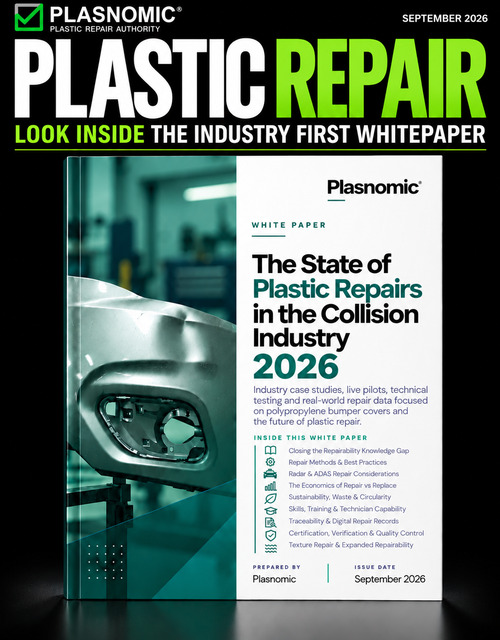
This white paper is designed to address those questions as one connected system. The first edition is U.S. focused, while drawing on international repair knowledge and collaboration. It combines practical repair experience with controlled testing and operational evidence, creating a foundation that other markets can later adapt to their own vehicle parc, labor environment, insurer practices and regulatory conditions.
Closing the Repairability Knowledge Gap
Repairability is often limited less by the physical capability of the material than by uncertainty: uncertainty about damage limits, process selection, technician capability, documentation and responsibility. The paper will map where those gaps occur and distinguish between what is known, what has been demonstrated in practice, what requires OEM direction, and what still requires further research. The objective is a more disciplined repair-versus-replace decision rather than an assumption in either direction.
Repair Methods & Best Practices
The technical section will examine polypropylene bumper-cover repair across multiple approaches, including filler-less plastic welding and repairs incorporating two-part repair materials. It will focus on process discipline: identification of substrate, damage assessment, preparation, welding or bonding method, finishing, texture restoration, quality checks and documentation. The emphasis is repeatability and fit-for-purpose outcomes, not simply whether a damaged cover can be made to look acceptable.
Specialty Tools & Materials
Specialty tools and materials can have a significant influence on repair quality, consistency and technician productivity, but not every product delivers the same practical value. The white paper will examine which tools materially improve repair control, access, shaping, welding, finishing and repeatability, and which have a more limited impact in day-to-day operations. Understanding where specialized equipment and repair materials genuinely add value is essential to building an efficient, scalable repair process without unnecessary complexity or cost.
Radar & ADAS Repair Considerations
As radar and other sensing technologies increasingly interact with bumper-cover zones, cosmetic success alone is not enough. The paper will summarize comparative testing intended to better understand substrate and repair effects on radar transmission and signal loss. These findings are presented as technical information and a basis for further study, not as a substitute for OEM repair procedures, calibration requirements or vehicle-specific restrictions.
The Economics of Repair vs Replace
Repair decisions have direct consequences for total repair cost, labor capture, parts spend, gross profit, cycle time and parts availability. The paper will use live pilot data and case studies to examine the economics from multiple viewpoints: repair facility, insurer and customer. It will also explore why a lower parts invoice does not automatically mean lower business value, particularly when repair can convert external parts spend into skilled labor while avoiding ordering, receiving and handling a replacement component.
Skills, Training & Technician Capability
Scaling plastic repair requires more than equipment and materials. It requires a defined skill set, structured training, practical repetition, assessment and ongoing development. The paper will explore specialist technician models, apprentice pathways, micro-learning, certification and the role of digital and AI-supported guidance. The workforce opportunity is significant: plastic repair can become a specialized career pathway while helping shops address labor shortages and retain more repair work internally.
Sustainability, Waste & Circularity
A replaced bumper cover does not automatically need to become waste, and a repairable bumper cover does not automatically need to be replaced. The paper will examine how better repair decisions can prevent waste at source, while also addressing the need for responsible pathways for components that genuinely cannot be repaired. The wider goal is circularity: preserve the part where appropriate, recover value where possible, and create a more accountable route to recycling or disposal when the component reaches end of life.
Traceability & Digital Repair Records
A credible repair system should be able to show what was repaired, where the damage was located, which process and materials were used, who performed the work and what verification occurred. Digital repair records can create that chain of evidence through images, repair checkpoints, technician identity, material selection and part-level records. Traceability also creates a foundation for future auditing, warranty support, insurer confidence, reuse decisions and circular-part management.
Certification, Verification & Quality Control
Certification should represent demonstrated capability, not simply course attendance. The white paper will explore a framework that connects technician training, process compliance, equipment and materials, documentation and verification. The objective is a repeatable quality system in which repair outcomes can be reviewed against defined checkpoints and supported by evidence.
Texture Repair & Expanded Repairability
Texture damage is one of the areas where otherwise repairable bumper covers are frequently replaced. Improved texture-repair methods can expand the practical repair envelope when performed to an acceptable visual and technical standard. This section will examine the role of texture restoration within a broader repairability strategy and how specialist capability can convert marginal replacement decisions into viable repairs.
From Individual Repairs to an Industry Framework
The larger opportunity is not a single repair technique. It is the creation of a connected repair ecosystem in which repairability guidance, technician capability, technical validation, economics, documentation, certification and circularity reinforce one another.
Plasnomic’s aim is to provide the collision industry with a practical reference point: a common language for plastic repair, a clearer understanding of the opportunities and limitations, and a roadmap for moving from inconsistent individual practices toward a measurable, documented and continuously improving repair discipline.
