

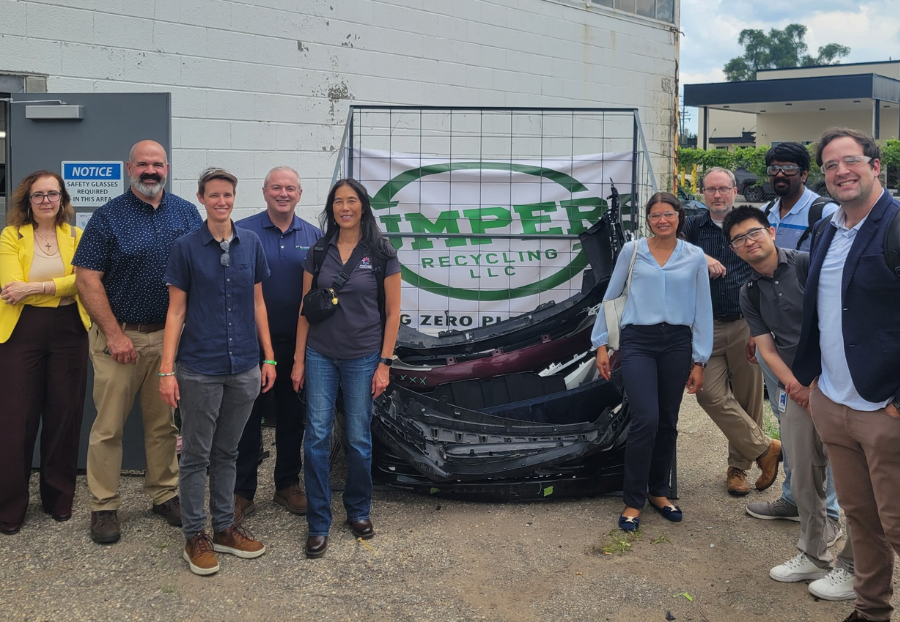
Detroit, Michigan — July 2026 — Plasnomic recently had the pleasure of hosting representatives from several U.S.-based OEMs, government bodies, research organizations and collision repair industry partners at Gerber Collision & Glass in Detroit.
The primary focus of the visit was to see firsthand how Gerber is managing end-of-life automotive plastic parts across the Detroit region and to explore how its established program could be scaled into a broader, more structured industry model.
Over the past 18 months, Gerber has developed a coordinated process for collecting plastic parts from its collision repair locations throughout the region. The program has diverted tens of thousands of components from landfill while working with key partners to process recovered materials into valuable by-products for a range of industrial applications.
The day began at USCAR’s Detroit facilities, where the delegation discussed the initiative’s broader objectives and the opportunities for greater industry collaboration.
The group then visited Gerber Collision & Glass to observe its collection and material-management processes in operation. The visit provided valuable insight into the infrastructure, partnerships and operational requirements needed to establish and sustain an effective automotive plastic recovery program.
Building on Gerber’s progress, discussions focused on how the model could be expanded across a wider collision repair network and supported by OEMs, government bodies, research organizations, insurers, recyclers and other industry stakeholders.
Rather than continuing to treat damaged bumper covers and other automotive plastic components as low-value waste, the initiative will explore the development of a controlled and regulated recovery pathway that maintains material traceability, supports responsible processing and creates greater economic value through the production of usable by-products.
A coordinated industry model could significantly increase landfill diversion while creating a more transparent, commercially sustainable and circular system for managing automotive plastic waste.
Capturing the Value of Automotive Plastic Waste
Automotive plastic waste is not a single, uniform waste stream. Different components carry significantly different material, repair, reuse and residual values.
Bumper covers represent one of the highest-volume plastic waste streams generated by collision repair facilities. Their scale creates a major opportunity to establish coordinated collection, material-separation and processing systems capable of converting large volumes of recovered plastic into commercially valuable by-products.
The group discussed the opportunity to develop a coordinated recovery system that could support:
- Structured collection from collision repair facilities
- Identification and separation of automotive plastic types
- Traceability throughout the recovery process
- Responsible processing and recycling
- Conversion of recovered plastic into usable by-products
- Measurement of environmental and economic outcomes
- Stronger collaboration between OEMs, repairers, recyclers and material processors
The objective is not simply to remove waste from collision repair facilities. It is to build a transparent system that preserves the value of the material and creates a commercially viable circular pathway.
While bumper covers represent one of the largest opportunities from a volume perspective, and some core generate resale value, headlights are increasingly becoming the highest-value waste stream within automotive plastic parts. Replacement headlight assemblies can cost up to $10,000 on some newer vehicles, while used headlight cores may carry an average value of approximately $75, with some damaged cores selling for more than $500.
Modern headlight assemblies contain far more than plastic housings and lenses. They can include advanced electronics, LED modules, control units, sensors and vehicle-specific technologies, giving damaged and replaced headlights substantial residual, repair and core value.
This means the industry must look beyond recycling headlights solely for their raw material content. A structured recovery model should first determine whether a headlight can be safely repaired, reused, remanufactured or recovered for legitimate component value before it is processed as material waste.
By improving how automotive plastics are collected, identified, assessed, tracked and processed, the industry has an opportunity to move beyond basic landfill diversion. It can create valuable secondary material streams while also protecting and recovering the significant core value contained within high-value components such as headlights.
Building a Regulated and Commercially Sustainable Model
Meaningful progress will require collaboration between OEMs, government bodies, research organizations, collision repairers, insurers, suppliers, recyclers, technology providers and law-enforcement stakeholders.
Any future system must deliver more than environmental benefits. It must also create commercial value, protect legitimate ownership, support responsible businesses and provide the transparency required to manage increasingly valuable vehicle components.
A scalable model could provide the industry with a structured pathway for separating high-volume material recovery from high-value component recovery.
For bumper covers and similar parts, the focus may be on efficient collection, sorting, processing and conversion into valuable by-products. For headlights and other advanced components, the priority may be repair assessment, ownership verification, core tracking, remanufacturing and responsible reuse before final material recycling is considered.
As Plasnomic continues its transition into a software-driven best-practices, traceability and knowledge-sharing solution, collaboration with these industry stakeholders will be essential to developing scalable systems for plastic-waste recovery, by-product creation and core-part management.
Plasnomic thanks Gerber Collision & Glass for hosting the delegation and supporting these important industry discussions.
Together, the industry has an opportunity to transform automotive plastic waste into a valuable resource while creating a safer, more transparent and more accountable system for the recovery, tracking and reuse of high-value automotive parts.
