
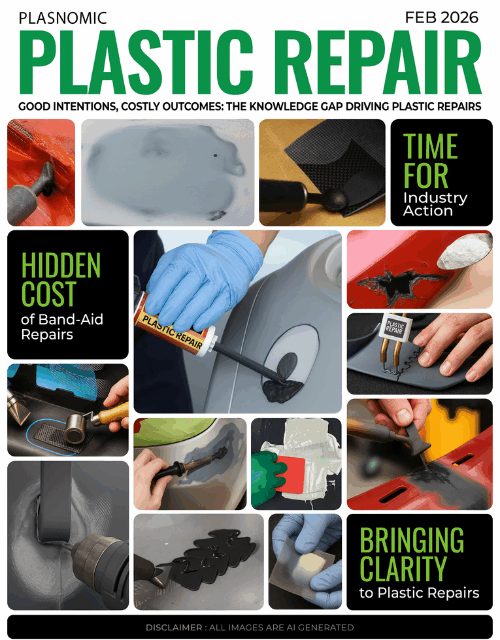
The real cost of Band-aid solutions
Plastic repair has become one of the most important and most misunderstood disciplines in modern collision repair.
Today’s vehicles are engineered around lightweight plastics, particularly polypropylene blend bumper covers, which make up the overwhelming majority of modern exterior plastic components. Technicians are being asked to repair these parts more than ever before. Yet despite this shift, plastic repair has evolved into a fragmented landscape of unknown around welders, adhesives, fillers, reinforcement methods, and improvised solutions.
Some methods work. Some work temporarily. Some never had a chance, as they weren’t engineered for today’s automotive plastics.
They just add cost and time to the repairs, and potentially increase the chance of failure.
This is not a matter of technician capability or shop intent, as collision professionals are working with what they have been taught, supplied, or exposed to in the past. The problem is that as the number of repair methods has grown, so too has the gap between what merely looks repaired and what is truly safe, durable, and OEM-compatible.
Walk through enough repair facilities across the world, and you will see the full spectrum. Metal staples melted across torn sections. Mesh patches bonded behind cracks. Two part epoxies filling gouges. Soldering irons reshaping substrates. Reinforcement plates riveted behind splits. Repairs sculpted with heavy layers of body filler.
To the untrained eye, these may appear resourceful. Unfortunately, many of these methods are temporary structural compromises rather than suitable repairs.
Modern bumper covers are not cosmetic skins. They are engineered impact management components. Polypropylene blended with EPDM is designed to flex, absorb energy, expand and contract with temperature, and distribute force during collision events.
When rigid fillers or chemically incompatible materials are introduced into that system, the repaired section often loses the very characteristics the part was designed to provide.
Over time, the consequences become visible. Stress fractures develop along repair lines. Heat cycle fatigue causes cracking. Delamination occurs. The repaired area stiffens while the surrounding substrate remains flexible, creating tension points that eventually fail. In many cases, this is not the result of poor workmanship, but of incompatible material science.
The hidden cost to the industry is significant. What begins as a quick cosmetic solution can quickly escalate into rework during assembly, warranty returns, or full replacement after premature failure.
The financial impact compounds across labor time, materials, cycle time, and customer confidence. In some instances, the cumulative cost of an improper repair far exceeds the cost of executing the correct method from the start.
Beyond cost, there is a growing safety dimension, as modern bumper systems integrate absorbers, brackets, and sensors that influence advanced driver assistance systems. A repair that stiffens a flexible impact zone or alters energy dispersion characteristics changes how that bumper behaves during a subsequent event. This matters to manufacturers. It matters to insurers. And it matters to consumers who assume their vehicle has been restored to its engineered pre-accident condition.
Compounding the challenge is how loosely the term “plastic repair” is used across the industry. Welding, bonding, patching, gluing, melting, reinforcing are very different processes, and often are described under one umbrella term.
Without defined terminology and repair criteria, the industry struggles to set expectations, OEMs cannot protect engineering intent, and shops are left navigating marketing claims instead of material compatibility.
The majority of modern bumper covers are polypropylene based, and this material behaves differently from many other plastics. It has memory and can be reshaped with controlled heat. It requires a compatible polypropylene material to properly fuse splits or tears. It demands repair processes that restore flexibility rather than override it with rigidity.
When chemically compatible polypropylene is fused using correct heat control and technique, the repair becomes part of the original structure as opposed to a layered filler or patch. The closer the repair replicates the original material properties, the more effectively it preserves performance.
This is not about rejecting the past. It is about aligning with the engineering realities of modern plastic parts materials.
The industry now stands at an important crossroads. Plastic repair is no longer a niche capability. It is one of the most frequent, most economically-significant, and most technically-sensitive procedures in collision repair. Yet it remains one of the least standardized.
‘Shops want opportunity. Technicians want clarity. Insurers want predictability. OEMs want integrity. Customers want safety and confidence’.
The path forward requires clarity, not complexity. Clear polypropylene repair criteria. Clear material compatibility standards. Clear definitions of what constitutes a structurally sound repair.
If standards are not established, the risks, financial, environmental, and safety related will continue to grow.
The mission ahead is straightforward. Repair plastic according to the science of the material. Restore flexibility and energy absorption characteristics. Eliminate incompatible materials where possible. Replace guesswork with engineering discipline.
Plastic repair done correctly protects the integrity of the vehicle. Plastic repair done incorrectly risks compromising it.
Time for Industry Action
This is where Plasnomic, together with its industry partners and the Global Plastic Repair Alliance Council, will now take action. After intense research and industry first collaborative work being done.
Beginning in early March, Plasnomic will move from evaluation of all processes to structured validation, working with the extended technical ambassadors.
The first objective will focus specifically on polypropylene-blended bumper covers, which represent the overwhelming majority of modern exterior bumper cover and bolt on plastic components.
The work will concentrate on the five most common and commercially critical repair categories:
– Alignment tab.
-Non-alignment tab.
-General impact (non-penetration).
– Split-to-edge ( top ).
-Splits within the substrate.
By addressing these core damage types first, Plasnomic will establish a practical and repeatable foundation for polypropylene repair, grounded in real-world shop conditions and validated by engineering discipline.
This next phase will include both controlled practical testing and laboratory-based validation within an OEM-accredited automotive testing environment. Repair processes will be evaluated for structural integrity, material compatibility, flexibility retention, heat-cycle durability, and the influence on ADAS and radar performance.
Guidance will be driven by a network of Technical Ambassadors, respected plastic repair leaders, material experts, and engineering professionals ensuring that field experience aligns with scientific validation.
The objective is clear: define safe repair pathways, reduce unnecessary part replacement, improve cost predictability, and ensure repaired components perform as originally engineered.
Plastic repair can no longer be left to interpretation.
The industry must now choose structure over improvisation, validation over assumption, and engineering over guesswork.
Repair — or ruin.