Plasnomic is leading the transformation of plastic repair, bringing clarity to an industry long shaped by uncertainty, through expert collaboration, real-world validation, and ISO-backed laboratory data.
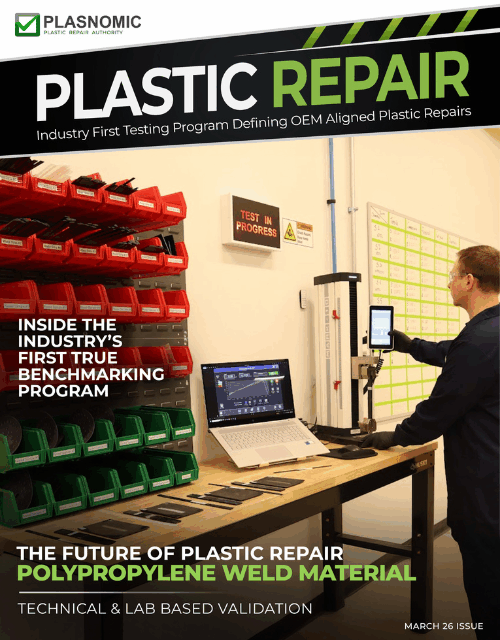
As the global authority on automotive plastic repair, Plasnomic has commenced benchmarking and testing of the core material underpinning modern repair processes: polypropylene weld. This industry-first initiative marks a significant step forward in establishing OEM-aligned best practices, backed by a structured framework of technical expertise, council oversight, and scientific validation.
At a time when the collision industry continues to wrestle with one of its most persistent challenges—understanding which plastic repair processes and products truly perform, Plasnomic is taking decisive action.
In a major milestone for the sector, Plasnomic has launched a structured testing and validation program that brings together ISO-accredited laboratory analysis, real-world repair evaluation, and deep technical expertise from across the industry. The program is designed to eliminate long-standing ambiguity and create a clear, evidence-based pathway for plastic repair.
For decades, plastic repair has operated in a fragmented environment. Decisions have often been driven by manufacturer claims, technician preference, or localized training methods, rather than objective and comparable performance data. While materials and technologies have evolved rapidly, the industry has lacked a unified system to validate performance, durability, and long-term repair integrity.
Why Polypropylene Weld Materials Lead the Program
Modern bumper covers are predominantly manufactured from polypropylene blends. True repair integrity requires materials that fuse chemically and structurally with the original substrate, not simply adhere to it.
Plasnomic has sourced weld materials from over a dozen leading plastic repair providers around the world to evaluate key performance characteristics. These materials are being benchmarked against multiple OEM polypropylene bumper cover samples to establish true comparative performance.
Testing is focused on five critical performance categories:
• Weldability
• Sandability
• Blendability
• Structural strength
• Impact resistance
Among these, blendability has emerged as one of the most critical indicators of repair quality. The ability for a weld to seamlessly integrate back into the original plastic, without the need for fillers, signals a shift toward a more advanced, OEM-aligned repair methodology.
When executed correctly, this enables a direct transition into refinish, improving overall repair quality, reducing warranty comebacks, shortening cycle time, and lowering reliance on additional materials such as fillers. More importantly, it allows the part to perform, flex, and absorb stress as originally intended by the OEM without being compromised by foreign material build-up that can hinder performance, lead to premature failure, and create risks with radar and ADAS compatibility
To ensure credibility, Plasnomic has partnered with a world-class ISO-accredited laboratory in the United States, operating under Automotive OEM-aligned testing protocols. This provides a scientific foundation for the program, with all data independently validated and documented.
However, Plasnomic is not relying on laboratory results alone.
This dual-validation approach combining scientific testing with live repair application, sets a new benchmark for how plastic repair products are evaluated.
Recognizing that real world performance often differs from controlled environments, the program will be supported by Plasnomic’s Technical Ambassador Team, set to be announced in mid April. This group of highly experienced plastic repair and collision specialists, actively working within repair facilities, will play a critical role in bridging the gap between lab testing and shop floor reality. Their focus is to validate how materials perform in practical conditions, ensuring that laboratory results translate into consistent, real world repair outcomes.
The implications of this initiative extend far beyond individual product testing.
The results will form the foundation of Plasnomic’s Approved Product Line and grading system, a structured and transparent framework that will classify products based on verified performance. This information will be made accessible through the Plasnomic Exchange platform, creating a centralized knowledge base for collision repairers, MSOs, OEMs, insurers, and industry partners.
For the first time, the industry will have access to a single, data-driven source of truth removing reliance on anecdotal experience and marketing claims.
Expanding Beyond Weld Materials
Polypropylene weld materials represent the starting point—but not the endpoint.
Plasnomic’s testing framework is already expanding to include:
• Abrasives and surface preparation systems
• Plastic welding equipment and heat control tools
• Texture and grain replication systems
• Headlight and tab repair solutions
• Finishing and shaping tools
• Emerging specialty materials and technologies
Any component that impacts structural integrity, surface finish, or safety performance will fall within scope as the program evolves.
Plastic components, particularly bumper covers and lighting systems, now represent some of the most frequently replaced and highest-cost elements within modern collision claims. At the same time, increasing pressure around sustainability, cycle time, and cost efficiency is driving a renewed focus on repair over replacement.
Yet without clear standards and validated processes, scaling plastic repair has remained a challenge.
Plasnomic’s approach addresses this gap directly by moving plastic repair away from subjective decision-making and toward measurable, repeatable outcomes. It is a transition from opinion to evidence, from variability to consistency.
Ultimately, the goal is not just to test products, but to define what “good” looks like in plastic repair and to make that definition accessible to the entire industry.
As this program progresses, it signals the beginning of a new chapter one where plastic repair is no longer treated as an uncertain alternative, but as a fully engineered, validated, and trusted solution within the collision repair ecosystem.