

Chicago, IL—May 18, 2026—Plasnomic announced today that it has completed the first stage of its global polypropylene bumper repair benchmarking initiative, marking a major step toward the development of industry best practices for repairing damaged polypropylene bumper covers.
“We are excited to bring this new development to the industry as we move closer to establishing data-driven and technical best practices for plastic repairs,” said Mario Dimovski, Head of the Plasnomic Global Council.
The testing program is being conducted under an IATF 16949 certified quality management framework for automotive product development. This provides a structured automotive-grade foundation for process review, documentation, supplier comparison, and best-practice development.
Plasnomic said the initiative has been designed to address one of the most important technical questions facing the collision repair industry: how different plastic repair materials and methodologies affect the performance, durability, flexibility, and consistency of modern polypropylene bumper repairs.
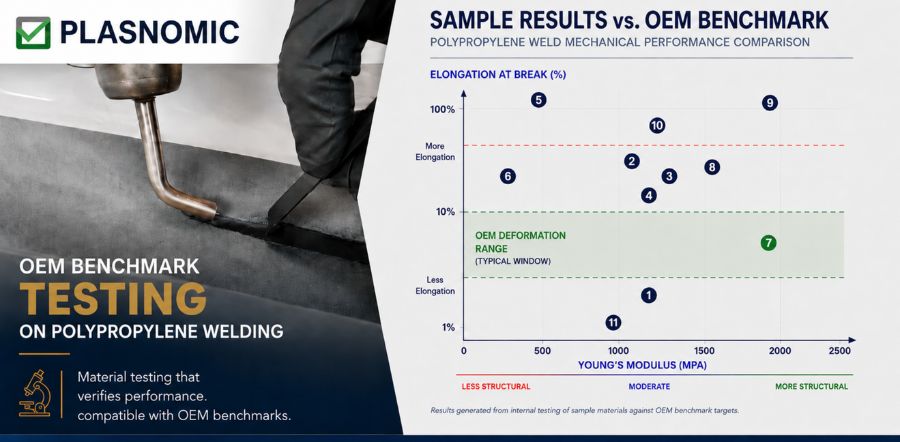
The first phase focused on evaluating weld materials and fusion repair methodologies currently used across the global collision repair industry. The objective was to identify repair substrates and fusion methods that most closely preserve the original characteristics, flexibility, and performance behavior of OEM polypropylene bumper systems.
The benchmark testing included comparative evaluation of repair materials and fusion approaches from 11 globally recognized plastic repair solution providers across North America, Europe, and Asia Pacific markets.
Initial findings demonstrated meaningful variation between repair materials and weld methodologies. Plasnomic said these results reinforce the importance of establishing a technically validated, OEM-compatible repair substrate before broader comparisons of repair methods are conducted.
Through this first stage of evaluation, Plasnomic has identified a foundational OEM-compatible repair substrate that will now serve as the benchmark for the next phase of comparative repair methodology testing.
Next Phase: Comparative Repair Methodology Evaluation I
With the OEM-compatible weld benchmarking phase now complete, Plasnomic is advancing to the next stage of evaluation, focused on comparing major polypropylene repair methodologies and their effects on modern bumper system performance.
This next phase will assess common industry repair approaches, including filler-based plastic repairs, two-component adhesives and epoxies, reinforcement and staple-based methods, fusion-based methodologies, and hybrid repair processes.
Each methodology will be evaluated against the benchmark OEM-compatible repair substrate identified during the first testing phase.
The objective is to better understand how different repair methods influence component flexibility, structural integrity, repair thickness, cycle time, labor profitability, process application, material consumption, operational cost, sustainability, and overall repair performance outcomes.
Particular focus will be placed on advanced driver-assistance systems (ADAS)-sensitive areas, where material thickness, density, substrate consistency, and repair composition may influence modern bumper system performance.
Toward the First Best Practices for Polypropylene Bumper Cover Repairs
The completion of these testing phases will support the development of best practices for polypropylene bumper cover repair and lead to the publication of an industry white paper grounded in data-driven testing, technical evaluation, and evidence-based analysis.
The goal of the white paper is to help repairers, insurers, OEM stakeholders, training organizations, suppliers, and industry leaders better understand how different repair methods influence flexibility, durability, repair quality, process efficiency, sustainability, and modern vehicle system integration.
Its purpose is to establish a practical and technical foundation for safer, more consistent, OEM-conscious, and environmentally-responsible plastic repair decisions across the global collision repair industry.
For media inquiries, interviews or further information, please contact:
Stacey Phillips Ronak
stacey@radiantwriting.com
858-401-2692
