

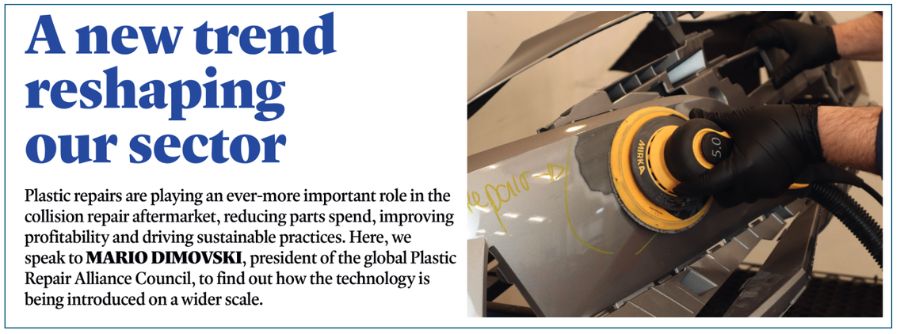
What are the key benefits of plastic repairs to workshops, customers, and the environment?
For collision shops, the impact is immediate and measurable. Plastic repair improves gross profit, reduces cycle time, and significantly lowers reliance on parts procurement—an increasingly critical advantage amid ongoing supply chain pressures and rising component costs.
Equally important, it enables the introduction of specialized roles, such as dedicated plastic repair technicians, allowing shops to increase throughput and capacity without the need to expand physical infrastructure. It also reinforces a core commercial principle of the collision industry: shops sell labour, not parts—making repair a far more controllable and profitable model.
For customers, the value is clear: faster repairs, lower costs, and a more seamless experience during what is often a stressful process.
From an environmental standpoint, the benefits are substantial. Repairing high-volume components such as bumper covers and headlights reduces landfill waste, minimizes emissions associated with manufacturing and logistics, and directly supports the industry’s transition toward circular repair models. It is one of the most practical and scalable ways the collision industry can contribute to sustainability today.
How is the Plastic Repair Alliance Council bringing industry stakeholders together to introduce standardized plastic repair processes?
The Plastic Repair Alliance Council has been deliberately structured to represent the full collision ecosystem, repairers, insurers, OEM-aligned experts, product developers, and technical specialists.
Its role is to unify these stakeholders around a single, critical objective: defining what “correct” plastic repair looks like and supporting that definition with data, validation, and accessible tools.
This includes not only setting standards, but also developing software and information solutions that assist in certification, repair validation, and real-time technical support.
The Council operates through structured collaboration, combining real-world technician validation with laboratory-backed testing. Products and processes will not be approved based on opinion, they are rigorously evaluated against clearly defined performance criteria.
This creates a shared, evidence-based foundation that removes long-standing ambiguity and builds confidence across all stakeholders, from technicians on the shop floor to insurers and eventually OEMs at a strategic level.
What are the main challenges around standardization across multiple geographic markets?
The greatest challenge is fragmentation.
Each market operates within its own framework—different insurer models, training pathways, regulatory environments, and repair cultures. In many regions, plastic repair has developed informally over time, resulting in inconsistent methods, varying quality levels, and gaps in both technical knowledge and material understanding.
There is also inconsistency in terminology, process execution, and access to reliable information. Critically, there remains a significant knowledge gap in even the most fundamental areas, such as welding equipment, plastic identification, and the differences between filler-based and fillerless repair processes.
Our approach is not to impose a rigid global model, but to establish a clear and credible baseline—defined best practices, validated repair methods, and measurable outcomes that can be adopted and adapted locally.
By combining this global framework with a centralized knowledge exchange platform, we enable collaboration rather than isolation. Supported by approved tools, materials, and accessible technical guidance, the system is designed to be practical, scalable, and, most importantly, built by technicians, for technicians.
How do you propose to manage certification?
Our starting point is the development of clearly defined best practices for polypropylene bumper cover repairs, as this represents the highest-volume and most commercially significant plastic component in collision repair.
We are establishing standardized repair methodologies across six core damage scenarios:
- Impact, non-contracting (heat and push)
- Impact, penetrating (heat, weld, and push)
- Alignment tab repair (top mount)
- Splits extending to the edge
- Splits within the substrate
- Repairs where alignment tabs are missing
Each of these repair types is being technically defined and validated through a combination of real-world application and laboratory-based testing. The objective is to remove subjectivity and provide technicians with clear, repeatable repair pathways based on material behavior, not opinion.
These initial best practices form the foundation of the broader certification and standardization model. Once validated, they are deployed into the field through training, digital guidance, and compliance tracking, ensuring consistency in how repairs are performed, measured, and approved.
From there, the framework expands into additional plastic components and repair categories, creating a scalable pathway toward full industry standardization.
These best practices will then progress toward full standardization, with planned collaboration with OEMs forming the final layer.
What progress have you made to date, and do you have any projected timelines around standardization?
The progress over the past 12 months has expanded well beyond standards. We are now acting—and being recognized—as an industry authority. The pace has been both rapid and revealing, with many industry firsts achieved and more to come. We are transforming multiple aspects of plastic repair—from how repairs are performed, to knowledge delivery, technical support, and the advancement of repair-first initiatives between insurers and MSOs.
What began as a focused effort to define best practices quickly uncovered a much larger issue: the industry lacked a centralized source of knowledge, had a heavy reliance on replacement, lacked a consistent framework for repair, and, critically, lacked trust in repair outcomes.
We are also now representing the industry in government- and OEM-led programs focused on end-of-life plastics from collision repair operations, with several pilot initiatives planned for Q3 2026.
On the technical front, we have evaluated existing repair methodologies and established initial best practices centered on polypropylene bumper repairs—specifically addressing the most common repair scenarios seen at the shop level today.
We have also launched structured testing programs, beginning with polypropylene weld materials. Multiple industry samples are currently under evaluation, with testing focused on weldability, strength, blendability, and OEM compatibility. This approach combines real-world technician validation with laboratory-based analysis.
At the same time, we identified a critical gap in trust around repaired and reconditioned parts. To address this, we developed Phase One of the Plastic Repair Management (PRM) platform—a mobile and web-based system that enables repair tracking, remote certification, and unique part identification through a traceable digital ID.
What started as a council-led initiative has evolved into a much broader ecosystem—addressing knowledge, standards, certification, compliance, and repair traceability.
In response, we also developed Plasnomic Exchange, a global knowledge-sharing platform designed to support both open community collaboration and structured, real-time technical guidance. It provides a single access point for information, discussion, and problem-solving across the industry.
What role do you see the Plastic Repair Alliance Council playing going forward?
The Council will act as the central engine driving the future of plastic repair—while remaining a collaborative and supported network, not a top-down authority. Our focus is on being responsive to industry demand and addressing the critical gaps currently limiting progress.
Engagement within the Council is dynamic. Some members are highly active today, while others will play a more significant role as the initiative evolves. We maintain consistent communication and regular updates to ensure alignment and transparency across all members.
As we continue to grow, the Council is being restructured to include more MSO executives, insurance leaders, and, ultimately, OEM representation. It will operate as a flexible, evolving structure—bringing in the right expertise at the right time, based on the needs of each stage.
At present, our global members have varying levels of involvement. While regional requirements have been assessed, our primary focus is on core markets such as the United States and Canada, supported by targeted pilot programs in key regions including Italy, the United Kingdom, and Australia. This ensures both immediate impact and long-term global scalability.
Plasnomic’s role is to actively engage with Council members, support them, and work alongside them to identify and solve real-world issues impacting plastic repair adoption, consistency, and trust. This includes addressing technical gaps, process inconsistencies, and barriers to implementation at both the shop and insurer level.
With the launch of Plasnomic Exchange, we now have a centralized platform where information can be shared, and members can contribute within a transparent yet secure environment—further strengthening collaboration and industry-wide engagement.
Ultimately, this is about more than defining standards—it is about building the support system, infrastructure, and confidence required to transform plastic repair into a recognized, standardized trade with measurable economic and environmental outcomes.
