

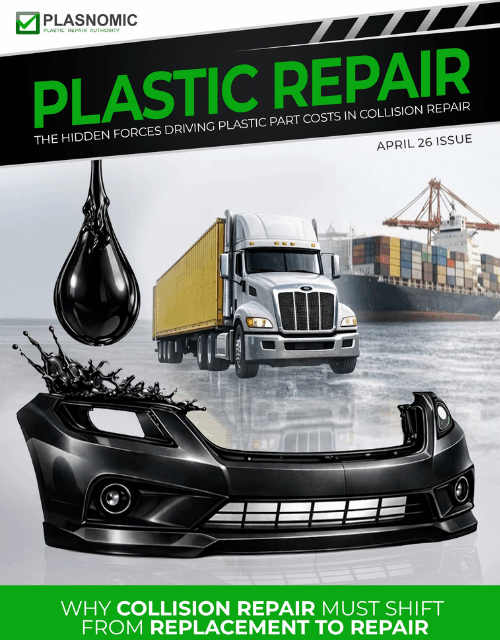
In 2026, the pressure is no longer abstract.
Consumers feel it every time they pull up to the pump. Fuel prices are sitting at record highs. Airlines are raising fares while warning of fuel shortages. Across global markets, energy has once again become one of the most dominant forces shaping cost.
But what is less visible, and far more consequential for the collision repair industry, is how deeply this energy crisis is now embedded in the cost of repairing a vehicle.
Because every plastic bumper cover begins its life as oil.
The Cost Chain No One Can Escape
Plastic automotive components are not just manufactured goods. They are petroleum products.
Bumper covers in particular are predominantly made from polypropylene and polycarbonate, materials derived directly from crude oil through naphtha-based refining processes. When oil prices move, these materials follow quickly and often aggressively.
In 2026, geopolitical tensions have already pushed plastic resin prices up by more than 30 percent year to date. That increase is not absorbed quietly within the supply chain. It moves rapidly, almost immediately, into the cost of replacement parts.
The mechanics behind this are unforgiving. Naphtha, the key feedstock used to produce plastics, can account for as much as 70 to 90 percent of total resin cost. A relatively modest ten-dollar increase in oil per barrel can drive a five to ten percent rise in plastic prices within weeks. At the same time, polypropylene, the industry’s preferred material for bumper covers due to its strength and flexibility has experienced significant volatility as supply has tightened globally.
This is further compounded by the nature of plastic manufacturing itself. High-heat injection molding processes are energy intensive, meaning rising energy costs layer directly on top of already inflated material prices.
The result is a system where cost increases are not gradual. They are immediate, compounding, and unavoidable.
Freight: The Multiplier No One Can Control
If oil drives production costs, it also drives the cost of moving parts, and in 2026, that movement has become one of the most volatile variables in the entire system.
Freight is no longer priced in static terms. It is dynamic, reactive, and increasingly automated through fuel-linked adjustments.
A recent increase of just 0.35 per liter in diesel has already translated into roughly a 17 percent rise on a standard one thousand dollar shipment. That change does not require negotiation or delay. It is automatically applied through fuel surcharges built into modern logistics contracts.
Major carriers are reinforcing this model. FedEx and UPS now adjust surcharges regularly, often weekly, while even national postal services are introducing fuel-based pricing mechanisms to offset rising transportation costs. The implication is clear: every fluctuation in fuel prices is immediately passed through to the cost of delivering parts.
And then there is the issue of size.
Bumper covers sit in one of the most expensive freight categories. Their large, bulky nature places them into additional handling or large package classifications, where shipping costs are already elevated. Fuel surcharges are applied as a percentage of that base cost, meaning any increase in fuel does not just add cost, it amplifies it.
At scale, this creates a disproportionate impact. Few components in a repair carry the same exposure to both material and freight volatility as a bumper cover.
A System Under Compounding Pressure
Layer onto this the ongoing instability in global logistics, port congestion, container shortages, disrupted trade routes, and the picture becomes clearer.
The industry is not dealing with a single issue. It is navigating a convergence.
Replacement part prices are rising. Material availability is tightening. Production is slowing. Delivery timelines are stretching, with many repairers now facing delays measured in weeks rather than days. Tariffs on imported components are adding further pressure, stacking additional cost on top of an already strained system.
Perhaps more concerning is what lies beneath the surface.
The automotive supply chain operates on a just-in-time model, leaving little room to absorb disruption. When materials are delayed or costs spike, there are few buffers to soften the impact.
And critically, not all of the cost increases have yet been realized.
Fuel surcharges adjust almost instantly, but broader manufacturing and supply chain costs tend to follow with a lag of several months. What the industry is experiencing today is only the front edge of a larger wave that is still forming.
It’s Time: From Replacement to Repair
If there was ever a moment that demands a fundamental shift in how we approach plastic parts in collision repair, it is now.
The industry is reaching a tipping point.
Repair costs are rising at an unsustainable rate. Write-offs are reaching record levels. Salvage yards are operating at capacity. And increasingly, customers are losing their vehicles, not because the damage is irreparable, but because the cost of repair has exceeded economic viability.
At the center of this issue sits a critical imbalance.
Plastic components now represent over 60% of the average parts cost within a repair, yet repair rates remain disproportionately low. Across the industry, less than 10% of headlights are repaired, and only around 25% of bumper covers are restored, figures that, in some regions, are significantly lower.
The gap between what is repairable and what is being replaced is substantial.
And it is driving the cost of repair higher and higher.
And yet, the industry continues to default to replacement.
That position is becoming increasingly difficult to justify.
The collision repair industry remains one of the few sectors where usable parts are routinely replaced rather than restored—despite the technical capability to repair them. At the same time, decisions around repairability are often influenced by inconsistent standards, limited training, or misaligned incentives, rather than technical reality.
This is the inflection point.
A moment where the industry has a clear choice:
Continue operating within a model driven by external cost pressures, supply chain instability, and increasing write-offs, or take control by fundamentally rethinking how plastic components are assessed and repaired.
Shifting from a replace-first to a repair-first mindset is no longer simply a technical consideration.
It is:
- An economic necessity
- An operational advantage
- And increasingly, a responsibility across the entire collision ecosystem
Because the future of collision repair will not be defined by how efficiently parts are replaced.
It will be defined by how intelligently they are repaired.
Across the industry, momentum is already building.
Organizations like Plasnomic, in collaboration with leading MSOs, insurers, suppliers, and government bodies, are driving meaningful progress to close the knowledge gap that has long limited plastic repair adoption.
Through structured training programs, standardized repair methodologies, and the development of dedicated plastic repair support centers, the industry is beginning to build the infrastructure required to treat plastic repair as a true specialty skill.
These initiatives are not theoretical; they are practical, scalable, and focused on results. The objective is clear: to significantly increase repair capability across the market, with a targeted ambition to double plastic repair rates within the next 18 months.
This is how the industry moves forward, not by reacting to rising costs, but by redefining how repairs are approached, executed, and valued.
By Mario Dimovski
Plasnominc – Head of Council
